Why Sim Local Is My Pick for the Best eSIM for Europe Travel (Especially for Multi-Country Trips)

The best eSIM for Europe travel is the one that covers you everywhere you want to go.Maybe that's one country, maybe it's 12. With how easy it is to move across borders in Europe, you'll want an eSIM you don't have to think about as you go.
After using a Sim Local eSIM across five European countries, I found it to be one of the easiest ways to stay connected while traveling through Europe.I didn't have to buy a new SIM card every time I crossed a border, I had mobile data as soon as I landed in Rome, and I could simply focus on enjoying the trip. If you're planning a multi-country itinerary, Sim Local is my pick for the best eSIM for Europe travel.
Last summer and fall, I visited Italy, Norway, Hungary, Spain, and Denmark over the course of two months and purchased just two 31-day eSIMs—not five separate ones. That's the beauty of using a regional Europe eSIM. Throughout the trip, I used it for Google Maps, WhatsApp, Google Translate, Instagram, travel research, and even hotspotting my laptop when café Wi-Fi wasn't strong enough for work.
This August, I'm headed back to Europe, starting in Albania. You can bet I'll be going the eSIM route again. I'll be working on my blog, sharing the trip on my Instagram, navigating a new language, and quite possibly adding more European countries to my itinerary as I go. Once again, I'll be relying on Sim Local to keep me connected.
Disclosure: This post was created in partnership with Sim Local and contains affiliate links. I may earn a commission if you make a purchase through my links, at no additional cost to you. All opinions and experiences shared here are my own and based on my real world use of Sim Local eSIMs.
Shop eSIMs: Check current Sim Local eSIM plans and use code NOMAPS for 5% off.
What is the best eSIM for Europe travel?
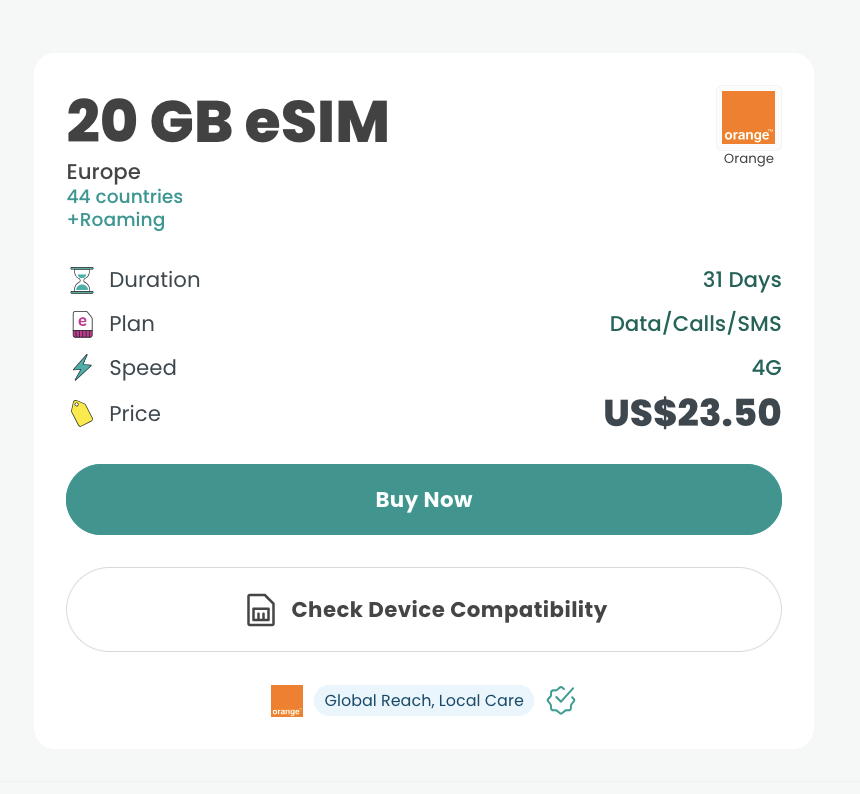
As I’ve already said, for multi-country trips, the best eSIM for Europe is one that includes all your destinations, lasts for the full length of your trip without needing a top up, and provides enough data for navigation, communication, social media, and, if you’re a digital nomad like me, solid internet for work.
Based on my firsthand experience, Sim Local is a strong option for travelers who want reliable connectivity across Europe without repeatedly buying or swapping physical SIM cards.
My Orange plan included unlimited calls and texts within the EU, plus international calling and texting allowances. I personally relied almost entirely on WhatsApp, but it's nice having traditional calling available when you need it.
When the 31-day period ended, I purchased another plan for the remainder of my trip.
Does one eSIM work across multiple European countries?
Yes. A regional Europe eSIM can work across multiple countries, provided every destination on your itinerary is included in that specific plan's coverage area. Keep in mind that not every plan marketed as a Europe eSIM covers every country geographically located in Europe. Coverage can vary, particularly for destinations outside the European Union.
Before buying, compare the plan's full country list with your actual itinerary. This is especially important for trips that include places such as Albania, the United Kingdom, Switzerland, or Turkey.
You can browse Sim Local's Europe eSIM plans by destination or region. Many of its unlimited data plans work in as many as 45+ European countries, potentially covering your entire itinerary with a single eSIM. In the Sim Local app or on their website, you can search for plans by destination or region. Alternatively, if you plan to spend most of your time in one country, you can search for a country-specific plan, with some options also including roaming in other destinations.
My experience using Sim Local across Europe
The best thing I can say about my Sim Local eSIM is that, once it was installed, I rarely had to think about it.
It simply did what I needed it to do: kept me connected as I traveled.
Setting up my eSIM before departure
I installed the eSIM on my unlocked iPhone 12 mini before leaving home and you can too. This meant that when I landed in Rome, I was already connected and able to navigate to my accommodation, check transportation information, and send messages without relying on airport Wi-Fi.
Arriving to a new place already connected is one of the biggest reasons I prefer an eSIM. The moment I land in a new country is often when I most need data…and when I’m at my most overwhelmed. The last thing I want to do is go find a kiosk to purchase a physical SIM card and likely get price gouged.
How to install your Sim Local eSIM
Download the Sim Local app and choose your destination.
Select the eSIM plan that best matches your trip.
Purchase your plan and tap Install Plan to begin the installation process.
Select "Download Plan" and follow the prompts to add the eSIM to your phone.
Tap "Allow" when your device asks for permission to install the eSIM profile.
Follow the activation instructions provided for your specific plan. I recommend setting everything up before you leave home so you're connected as soon as you land.
Arrive connected. Once you reach your destination, you'll be ready to use Google Maps, WhatsApp, translation apps, and everything else you normally rely on while traveling.
Note: If your eSIM isn't working after you arrive, double-check that you've selected your Sim Local eSIM for mobile data and that Data Roaming is turned on for that eSIM. While "data roaming" usually sounds like something to avoid, it's often required for travel eSIMs to connect to their partner networks abroad.
Crossing borders without changing SIM cards
The eSIM continued working throughout Italy, Norway, Denmark, Hungary, and Spain without requiring me to buy a new physical SIM card in each destination.
I don't have records showing the exact network speed or whether I was connected to 4G or 5G at every point, so I can't provide a technical speed comparison. What I can say is that the performance was reliable enough for everything I needed, and I don't remember experiencing any significant connectivity problems.
Working remotely and sharing data with hotspot access
As a travel blogger, I use more mobile data than someone who only needs maps and occasional messaging.
During the trip, I used my eSIM to navigate with Google Maps, communicate through WhatsApp, research destinations and transportation, upload content to Instagram, manage my blog, and hotspot my laptop when café Wi-Fi failed.
All Sim Local plans include hotspot and tethering—from the smallest 1GB plans to unlimited options—with no additional charge or usage restrictions. This is particularly useful for digital nomads, bloggers, remote workers, and content creators who need to connect a laptop or tablet on the go. It also means you can share your mobile data with a travel companion who doesn't have a connection of their own—a handy backup if a friend or family member runs out of data or simply needs to get online.
High-Data & Unlimited Plans: Check current pricing for Sim Local eSIM’s high-data and unlimited plans.
Why I prefer an eSIM for multi-country Europe trips
For me, the main benefit is being able to arrive already connected and continue traveling without arranging new phone service in every destination.
I've traveled extensively throughout Europe, often moving between several countries during the same trip. Sometimes I know exactly where I'm going months in advance. Other times (read: oftentimes)—as with my upcoming trip starting in Albania—I leave parts of my itinerary open and decide where to go next as I travel.
An eSIM suits that kind of flexibility.
I can install it before departure, use mobile data as soon as I arrive, and choose regional plans that cover multiple countries when my itinerary takes me across borders.
Immediate connectivity also makes the first few hours in a new destination considerably easier. I can navigate from the airport, contact my accommodation, look up train or bus information, access booking confirmations, use translation tools, or order a ride without first hunting for public Wi-Fi.
And because many eSIM-compatible phones allow you to keep your regular SIM installed while using the eSIM for mobile data, you may also be able to keep your usual phone number active. Just check your phone settings and home carrier's roaming policies carefully to avoid unintended charges.
Who is Sim Local best for?
Sim Local is particularly well suited to travelers who value convenient connectivity, want to arrange their data before departure, or need reliable internet access across one or more destinations.
Solo travelers
As someone who frequently travels alone, I rely heavily on my phone for navigation, transportation, booking information, and communication.
I prefer knowing I can land somewhere new and immediately access directions or contact my accommodation without depending on airport or public Wi-Fi.
Multi-country travelers
This is where I personally found Sim Local especially useful. I traveled through five countries using the same regional eSIM instead of arranging separate connectivity in each destination.
Just be sure the specific plan you choose includes every country on your itinerary.
Digital nomads, remote workers, and content creators
Sim Local's included hotspot and tethering can be particularly useful for travelers who need to connect a laptop or tablet while abroad.
I personally used my eSIM as a backup when Wi-Fi at the café or my accommodation wasn't strong enough for work.
Longer-term travelers
Sim Local can also work for longer trips, but pay attention to both the data allowance and the plan's validity period (usually a maximum of 31 days, with some plans—like any of Orange’s—offering the ability to top up and keep the same number)
My original plan lasted 30 days. Because my trip was longer, I purchased another plan to cover the remainder of my travels.
Short-term vacationers and families
Short-term travelers can choose a plan based on their destination, trip duration, and expected data use. For example, when I search eSIM plans for Albania, I see options that range from 20GB for 30 days to 1GB fro 3 days.
For families, the best setup will depend on how many travelers need mobile data and whether each person's phone is eSIM-compatible.
What are Sim Local's main benefits?
Sim Local combines the convenience of an international eSIM with access to established local and regional mobile networks.
My own Europe eSIM last summer was powered by Orange and worked reliably throughout all five countries I visited.
Select Sim Local plans also include calls and texts alongside mobile data. Some don’t, so read the fine print carefully. My Orange-powered plan came with unlimited EU minutes and texts and 30 minutes and 200 SMS for when I needed to communicate internationally, although I mostly relied on WhatsApp while traveling and never needed to send an SMS and rarely made a phone call outside of WhatsApp, though it was nice to have that option if I needed it.
Another feature I appreciate is that hotspot and tethering are included in all plans. That gave me the option to connect my laptop to my phone's data when Wi-Fi wasn't reliable.
Sim Local also offers 24/7 customer support by phone, email, and WhatsApp. I didn't personally need to contact support during my previous trip because my eSIM worked as expected, but round-the-clock assistance is reassuring when you're relying on connectivity abroad.
And if you're unsure which eSIM to choose, Sim Local's app interface is really easy to navigate and identify the eSIM that best suits your destination, data, and travel needs.
How much mobile data do you need for Europe?
The amount of mobile data you need depends on how you use your phone.
A light user who mainly needs maps, WhatsApp, email, and occasional web searches will use considerably less data than someone regularly uploading photos and videos, streaming content, working remotely, or hotspotting other devices.
As a travel blogger, I fall into the heavier-use category, so I always just purchase the maximum data available (usually 20GB+). I regularly use mobile data for navigation, research, communication, social media, and work. I also sometimes need to hotspot my laptop.
That's why I prefer a high-data plan. On my previous Europe trip, I had enough data that I never had to think about rationing my usage or constantly checking whether I was about to run out. For travelers who don’t want to closely monitor their data usage, Sim Local offers two unlimited eSIM options for Europe. Both include unlimited data, but the amount available at full speed each day differs.
| Plan | High-speed data | Coverage | Speeds | Best for |
|---|---|---|---|---|
| Unlimited | Up to 5GB per day at high speed, followed by reduced speeds | 36 European countries | 4G / 5G | Most travelers, including regular social media, navigation, browsing, streaming, and occasional hotspot use |
| Unlimited Pro | Up to 10GB per day at high speed, followed by reduced speeds | 36 European countries | 4G / 5G | Remote workers, content creators, frequent streaming, large uploads, and heavier hotspot use |
Plan availability, coverage, and terms can change. Check the current country list and plan details before purchasing.
Compare Sim Local eSIM unlimited plans and current pricing —and use code NOMAPS for 5% off.
If you’re a light user or only traveling for a week or two 3 to 5GB total might be more than enough. And if you’re a moderate user, 10GB is usually perfect across 31 days.
Choosing the right eSIM for your Europe trip
Before purchasing an eSIM for Europe travel, consider six things:
Which countries are you visiting? Make sure every destination is included in your chosen plan.
How long will you be traveling? Check the validity period as well as the data allowance.
How much data do you realistically use? Consider navigation, social media, streaming, work, and hotspot use.
Do you need calls and texts? Some Sim Local plans include them, while others are data-only.
Will you need to hotspot another device? Sim Local includes hotspot and tethering in all plans.
Are any of your destinations outside the EU? Don't assume every European destination is automatically included in the same regional plan.
Europe, the European Union, and the Schengen Area are not interchangeable. Always check the actual country list for the plan you’re considering rather than assuming every European destination is included.
If you're unsure which option is right for your trip, Sim Local's Find My Plan tool asks four quick questions to help match you with an eSIM based on your destination and travel needs.
How to install a Sim Local eSIM
After purchasing your eSIM (hopefully using my code NOMAPS for 5% off!), you'll receive installation instructions for adding it to your eSIM compatible phone (check if yours is here).
The exact steps depend on your device and plan, but it's generally best to confirm that your phone is unlocked and eSIM-compatible, install the eSIM before departure, follow the activation instructions carefully, and check when the plan's validity period begins (usually right upon install).
You'll also want to configure data roaming according to the instructions for your specific eSIM and save your purchase and installation information somewhere accessible offline.
I installed mine on an unlocked iPhone 12 mini before traveling and had connectivity immediately when I landed in Rome.
If you experience any issues, Sim Local provides 24/7 support by phone, email, and WhatsApp.
Is an eSIM better than a local SIM card or international roaming in Europe?
The best option depends on your destination, trip length, home carrier, and data usage.
| Option | Best for | Multi-country travel | Setup |
|---|---|---|---|
| Europe eSIM | Travelers seeking convenient connectivity before and during a trip | Good when all destinations are covered | Can usually be installed before departure |
| Local physical SIM | Longer stays focused on one country | Less convenient when crossing borders frequently, unless yours includes roaming | Usually purchased after arrival |
| Home carrier roaming | Travelers whose carrier offers affordable international service | Often convenient, but your most expensive option | Usually requires minimal setup |
For my own style of travel, an eSIM makes the most sense. I move between countries, use significant amounts of data, work online, and sometimes leave parts of my itinerary undecided.
Can a Europe eSIM cover EU and non-EU countries?
Yes, some plans cover a combination of EU and non-EU destinations, but coverage depends on the individual eSIM.
My previous Sim Local plan covered Italy, Norway, Denmark, Hungary, and Spain, plus about 40 other European countries.
My next trip begins in Albania, which is in Europe but isn't an EU member, which means I’ll have to choose from Albania-only plans. After Albania, I may continue to Spain, Ireland, England, or another destination, and will then be able to purchase a more comprehensive plan that covers more destinations or includes roaming.
Because my plans are open-ended, I'll check that each destination is included and use additional Sim Local coverage if necessary.
Is Sim Local worth it for Europe travel?
Based on my experience, Sim Local is absolutely worth considering for travelers who want convenient mobile data in Europe, particularly those visiting multiple countries, traveling solo, working remotely, or using a large amount of data. It’s much easier to install than a physical local SIM once you arrive and comes with the added benefit of 24/7 support from Sim Local should anything come up once you land.
I'm choosing Sim Local again for my upcoming open-ended trip beginning in Albania. For me, that's the strongest recommendation: I used it, it worked for the way I travel, and I'm using it again.
Browse eSIM Plans: Get your Sim Local eSIM and use code NOMAPS for 5% off.
Frequently asked questions about using an eSIM in Europe
Does one eSIM work in multiple European countries?
Yes. A regional Europe eSIM can work across several countries as long as each destination is included in the plan's coverage area.
Do I need a separate eSIM for every country?
Not necessarily. A regional eSIM may cover your entire multi-country itinerary on one plan.
Does a Europe eSIM work in the UK?
Many regional Europe plans include the United Kingdom, but coverage varies. Confirm that the UK is listed before buying.
Can I use WhatsApp with a travel eSIM?
Yes. You can use WhatsApp over the mobile data provided by your travel eSIM and generally continue using your existing WhatsApp account.
Can I keep my normal phone number?
Often, yes. Many compatible phones allow you to keep your regular SIM active while using an eSIM for data. Review your settings to avoid accidental roaming charges.
Can I use Sim Local as a hotspot?
Yes. Hotspot and tethering are included in all Sim Local plans.
When should I install my eSIM?
You can usually install it before departure, but follow the activation instructions for your particular plan. I installed mine before leaving home and was connected when I arrived.
Can I make calls and send texts?
Selected Sim Local plans include calls and SMS, while others are data-only. Check the individual plan details before purchasing.
What is the best eSIM for Europe travel?
Based on my firsthand experience across Italy, Norway, Denmark, Hungary, and Spain, I recommend any of Orange’s plans on Sim Local for travelers seeking convenient multi-country coverage across the EU, generous data options, hotspot capability, and 24/7 support.
Ready to stay connected on your own Europe trip? Browse current Sim Local eSIM plans and use code NOMAPS for 5% off your purchase.
Headed to Italy, Portugal, Spain, Hungary, or Latvia? Check out these travel guides:
Riga, Latvia: Before You Visit Riga: A Traveler’s Guide to Latvia’s Occupation History and How to Travel There Thoughtfully Today
Barcelona, Spain: Where Locals Actually Eat in Barcelona: A Food Tour Guide’s Picks by Neighborhood
Rome, Italy: Where to Eat Authentic Roman Pasta in Rome (Under €15) — A Local’s Picks
Naples, Italy: What to Eat in Naples: Must-Try Dishes, Desserts, & Deep-Fried Goodies in the Birthplace of Pizza
Budapest, Hungary: The Ultimate Guide to Budapest’s Jewish Quarter (District VII) — Eat, See, Stay + Historical Context
Florence, Italy: Where to Stay in Florence: A Neighborhood Guide for Every Vibe & Budget
Lisbon, Portugal: 7 Essential Dishes You Can’t Leave Lisbon Without Trying
What to Read Next


After nearly a decade of full-time travel, this is the gear at the top of my packing list each and every trip.