Florence Beyond the Crowds: Lesser-Known Museums & Sites That Reveal the City’s Deeper Story
This entry may contain affiliate links. This means if you click a link in this post and make a purchase, I may earn a small commission at no additional cost to you.
Looking for less crowded things to do in Florence? These quieter museums, churches, and historic sites offer a deeper, more contemplative way to experience the city.
It’s true. Florence is among the most crowded cities on the planet to visit, but that doesn’t mean you shouldn’t. Oases of peace and quiet do actually exist in Florence if you just know where to look for them. This post will point you to the lesser-visited, and no less stunning, sites in Florence that are the perfect antidote to the crowds, taking this city from feeling like a theme park to more like the layered, living city it truly is.
Many of the places in this guide were first shared with me by Florence-based guide Francesca Papi of Fantastic Florence, whose work focuses on helping travelers experience the city beyond the obvious icons.
Why These Are Some of the Best Less Crowded Things to Do in Florence
Florence’s overtourism is a problem because the crowds are unevenly distributed. A handful of headline attractions absorb the vast majority of foot traffic, while equally meaningful sites remain calm, crowd-free, and entirely accessible.
Choosing quieter museums, churches, and historic spaces in the city doesn’t just make for a better visitor experience; it’s also a more responsible way to travel, too. It spreads tourism beyond the same few streets, supports a wider range of institutions, and allows you to engage with Florence in an even deeper, underexplored way.
Medici Chapels: A Quieter Renaissance Site in Florence
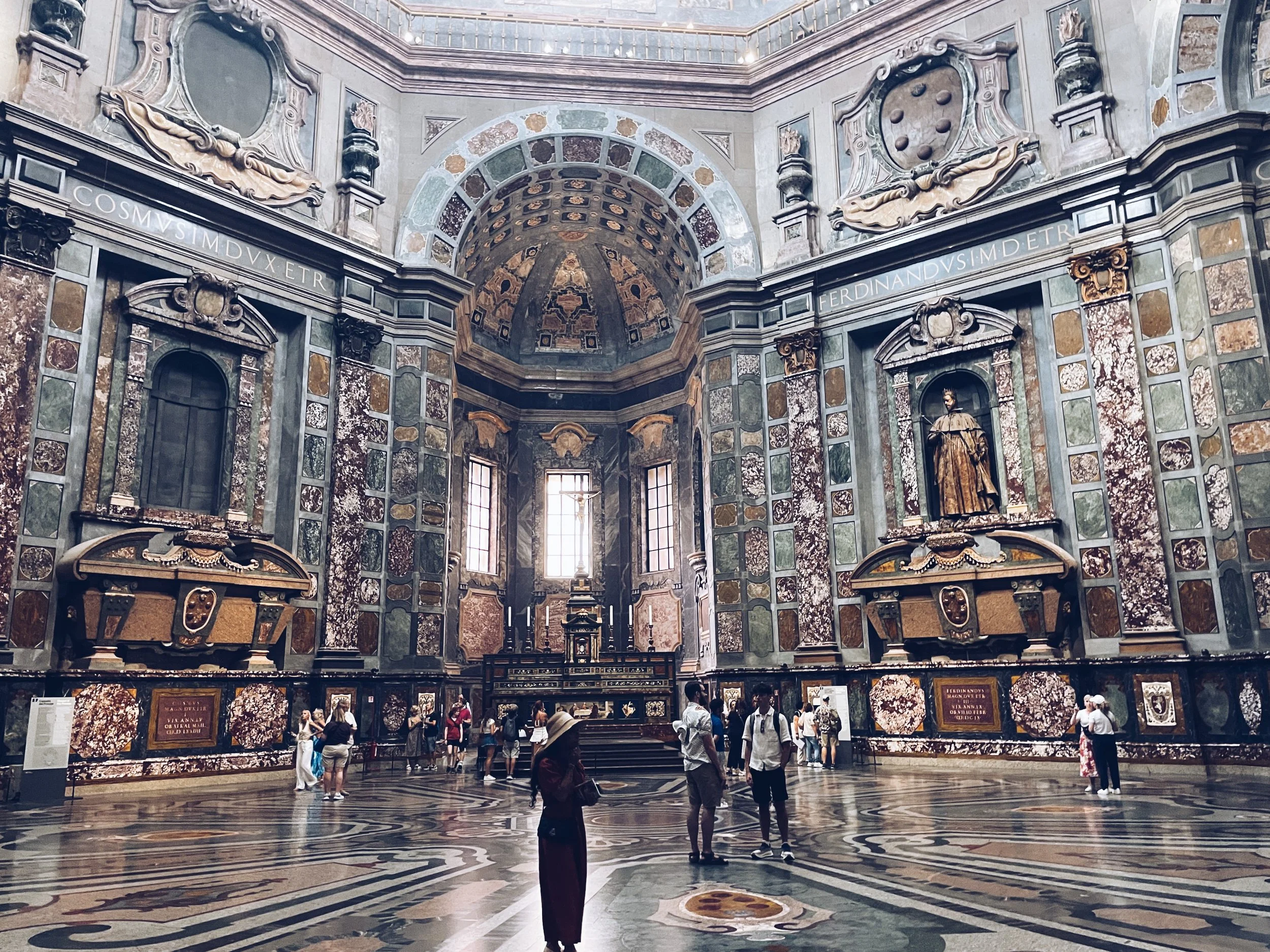
Chapel of the Princes inside the Medici Chapels
Tucked behind the Basilica of San Lorenzo, the Medici Chapels (Cappelle Medicee) are one of Florence’s most significant—and most overlooked—Renaissance spaces. This is where the Medici family, Florence’s most powerful dynasty, chose to memorialize themselves in a display of staggering wealth.
Once inside, you’ll encounter the Chapel of the Princes, a vast, octagonal hall encrusted in semi-precious stones and marble that feels like a literal monument to ego. This hall alone was so swoon-worthy that I included it my Florence Top 5 list.
The true heart of the visit, however, is Michelangelo’s New Sacristy. Here, his sculptural figures representing Night and Day, Dawn and Dusk, feel far more intimate than some of his better-known works, like David in the Galleria dell’Accademia and his Tondo Doni painting hanging in the Uffizi Gallery.
Recent years (as recent as 1975) have even added a layer of mystery to visiting the Medici Chapels: a "secret room" beneath the chapel reveals charcoal sketches Michelangelo scrawled on the walls while in hiding from a death sentence in 1530.
Ultimately, the Medici Chapels reframe Florence not as a city of isolated geniuses, but as a place shaped just as much by political ambition, image-making, and legacy. Despite their importance, the chapels remain one of the best alternatives to the city's busiest museums.
Know Before You Go:
Location: Piazza di Madonna Degli Aldobrandini, 6.
Tickets: A standard ticket (€9 for adults and free for children under 18) covers entry to the Chapel of the Princes and the New Sacristy (designed by Michelangelo). A combined ticket (€32 for adults) is required to visit Michelangelo’s hidden room and entry is limited to a few slots per day for conservation purposes. You can pre-book your tickets at B-ticket, the the only official website authorized by the Ministry of Culture for ticket purchases. Just note that there will be a €3 reservation fee added.
Hours: Open daily from 8:15 AM to 1:50 PM. Crucial Note: It closes every second Sunday of the month and every first, third, and fifth Monday of the month.
Dress Code: While technically a state museum, modest dress is still encouraged out of respect, though the rules are slightly more relaxed than active churches. Covering shoulders and knees is the general guideline.
Time: Give yourself an hour to an hour and a half to see it all at a nice pace
Tip: If you want to go deeper into the Medici story—the politics, the symbolism, the unfinished genius of Michelangelo—I highly recommend exploring it with Francesca Papi of Fantastic Florence. I had the chance to go on her Medici Family Tour when I was in Florence and I really appreciated hearing her expertise and insight as we wandered.
Basilica di Santo Spirito: A Hidden Michelangelo in a Lived-In Neighborhood
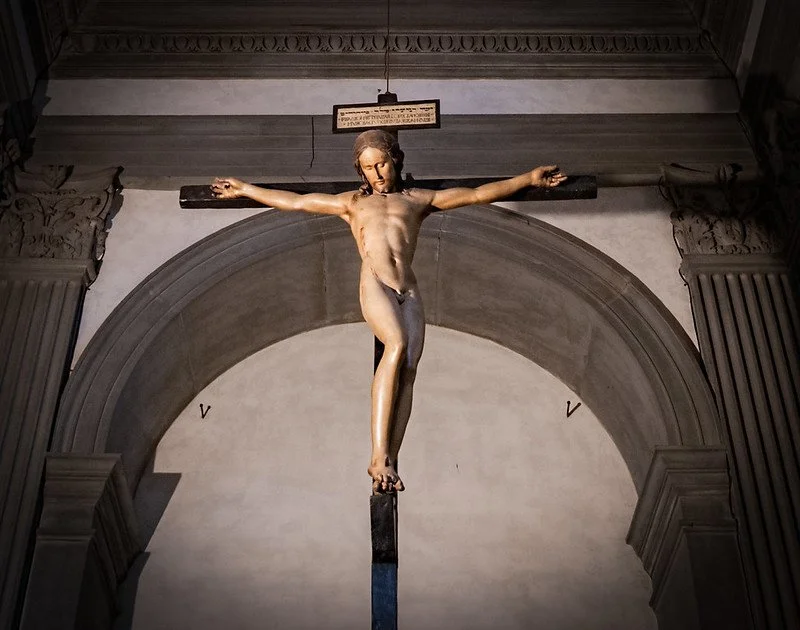
The wooden crucifix Michelangelo carved at 12 years old inside the Basilica di Santo Spirito (Photo Credit: Gary Campbell-Hall)
Across the Arno in the Oltrarno district (one of my favorite Florentine neighborhoods!), the Basilica di Santo Spirito anchors one of Florence’s most authentic piazzas. To add to its allure, every second or third Sunday of the month, an antique market sets up in the piazza, while evenings see the tables fill at the trattorias and cafés that line it. While you could view that as drawing a crowd (which this post is all about avoiding), the church anchoring the scene often and unfairly goes unseen.
At first glance and maybe as an explanation for the lack of visitors, the Santo Spirito’s simple plaster façade, an unfinished final masterpiece of Filippo Brunelleschi, gives little indication of what actually lies through its doors. Most notably, the wooden crucifix carved by Michelangelo at 12 years old as a gift to the friars who let him live there and study anatomy on the corpses from the convent’s hospital. It’s one of the artist’s most personal works—and one most visitors to Florence miss.
Beyond the Michelangelo crucifix, Santo Spirito is also a treasure trove of Renaissance art, from its massive 14th-century fresco of the Crucifixion by Andrea Orcagna in the former refectory to Filippino Lippi’s Nerli Altarpiece in the left transept, one of the only surviving examples of Late Gothic art in the city.
Know Before You Go:
Location: Piazza Santo Spirito, in the heart of the Oltrarno district.
Tickets: Entry to the main basilica is free of charge. An optional small fee (around €2–€3) is required to access the sacristy to view the famous wooden crucifix carved by Michelangelo.
Hours: Generally open mornings (10:00 AM – 1:00 PM) and afternoons (3:00 PM – 6:00 PM), with slightly different hours on Sundays. It is typically closed all day on Wednesdays.
Dress Code: As an active place of worship, a strict dress code applies: shoulders and knees must be covered. Photography and videos are prohibited inside the main church area.
Time: 30 minutes to an hour is all you need to experience Santo Spirito and all its treasures
Basilica di Santa Croce: Florence’s Thinkers, Not Just Its Artists

Often overshadowed by the looming marble of the Duomo, the Basilica di Santa Croce stands as the largest Franciscan church in the world. While it is the city’s second-largest temple—surpassed in size only by the Cathedral itself—it offers a markedly different experience.
Situated in the Piazza Santa Croce, exactly 800 meters southeast of the Duomo, this "Temple of the Italian Glories" (as it’s been nicknamed) serves as a collective memory for the nation. Here, Galileo, Machiavelli, and Michelangelo were finally laid to rest, their monuments standing as a reminder that Florence’s legacy goes far beyond just its aesthetic beauty. The church honors these scientists, philosophers, and artists alike, reflecting a century-spanning investment in both creative genius and rigorous scientific inquiry.
Despite its immense artistic wealth—including Giotto’s groundbreaking frescoes and Brunelleschi’s harmonious Pazzi Chapel—Santa Croce rarely feels overwhelmed by the typical Florentine bustle. It remains a place to slow down and consider how the city remembers its past: not just through its triumphs, but through the difficult, often dissenting intellect of those who had a part to play in shaping our modern world.
Know Before You Go:
Location: Piazza Santa Croce, a short walk across the Arno and east of the city center.
Tickets: Adult tickets cost approximately €10 for adults and are free for children under 18. Tickets can be purchased on-site or online with a €1 booking fee.
Hours:
Monday–Saturday: 9:30 AM – 5:30 PM (ticket office closes at 5:00 PM, last entry 10 minutes before close)
Sundays & Holidays: 12:30 PM – 5:45 PM
Dress Code: This is a consecrated church and active house of prayer. Visitors must dress appropriately with covered shoulders and legs. If you forget, the ticket office provides disposable cover-ups (robes/kimonos) free of charge.
Time: An hour is sufficient to explore the basilica in-depth
Fiesole: Florence Before Florence
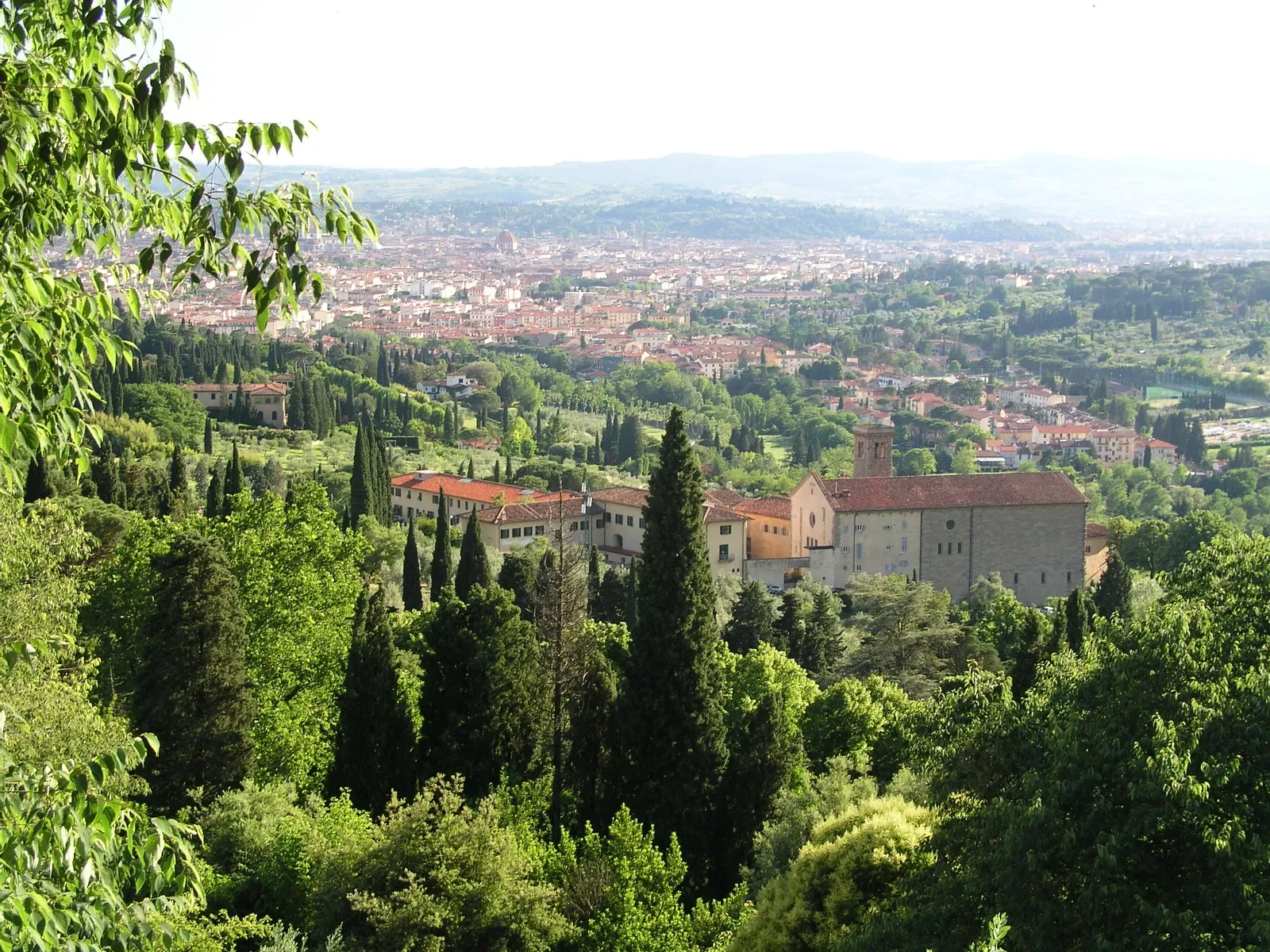
Photo Credit: Visit Florence
Just a short trip by taxi (10 minutes) or bus (20 minutes) uphill from the city, Fiesole offers one of the most rewarding and under-the-radar escapes from Florence’s crowds. While Florence feels like a Renaissance stage set, Fiesole is its ancient foundation; long before the Medici rose to prominence, this was a thriving Etruscan and Roman stronghold.
Today, you can sit in the tiers of a remarkably preserved 1st-century BC Roman Theater at the Musei di Fiesole or stand atop the San Francesco Convent for a panoramic view that helps situate Florence within a much older story. Its quiet, winding streets and sweeping vistas over the Arno Valley provide literal breathing room from the congestion of the historic center. Looking out from Fiesole doesn't just give you a better view of the Duomo—it gives you the essential geographical context for why the city below exists at all.
Know Before You Go:
Getting There: Take Autolinee Toscane Bus #7 from Piazza San Marco or Piazza della Libertà. It's a 20-minute climb to the final stop, Piazza Mino. Tickets are approx. €1.70 and must be bought at a tabacchi or newsstand before boarding. You could also call a taxi using one of the local ride-hailing apps and get there in 10 minutes for roughly €12 to €15.
Archaeological Area (Area Archeologica):
Tickets: Approx. €10 for adults, which includes the Roman Theater, Etruscan-Roman ruins, and the Civic Museum
Hours: Open daily in peak season (April–Sept) from 9:00 AM – 7:00 PM. In winter months (Nov–Feb), hours are typically shorter (10:00 AM – 3:00 PM) and the site is often closed on Tuesdays.
The Best View: From Piazza Mino, hike the steep 5-minute path up Via San Francesco. The panoramic terrace at the top offers the best uncrowded view of Florence.
Crowd Strategy: Fiesole is busiest on sunny weekends when locals visit for lunch. Visit on a weekday morning for the most solitude.
Time Required: Allocate 3–4 hours for a thorough visit, including transit and lunch.
Walking Note: The archaeological site and the path to San Francesco are steep with uneven ancient stones. Wear sturdy walking shoes.
Florence Synagogue: An Overlooked Layer of the City’s Identity
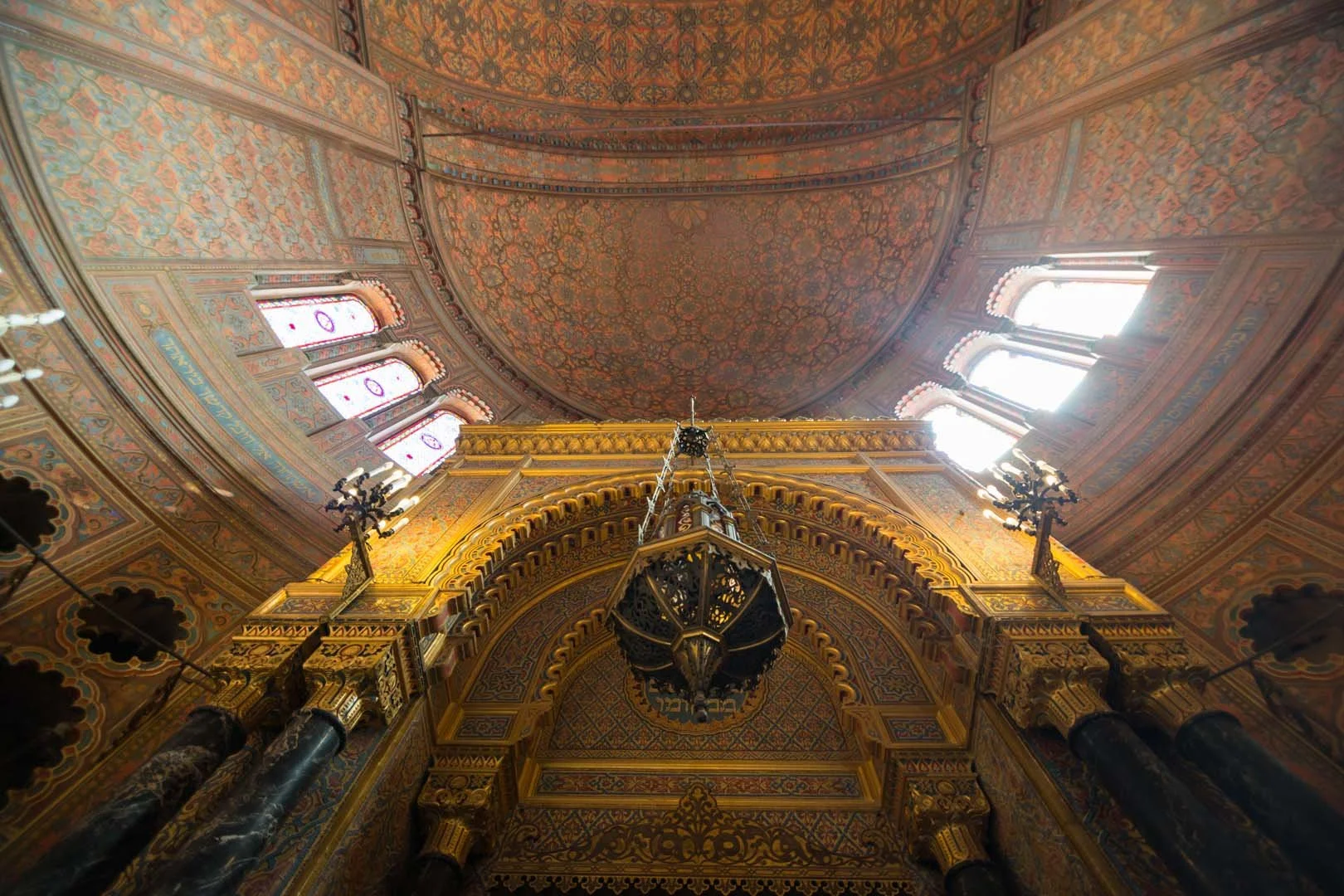
Photo Credit: jewishflorence.it
In the Sant’Ambrogio district, just near the Sant’Ambrogia Market (one of Florence’s most local food markets), stands the Florence Synagogue (Tempio Maggiore)—a striking 19th-century building and an often-missed cultural site in the city.
The synagogue and its museum offer a profound look into the city’s Jewish community, illuminating a history of coexistence, exclusion, and resilience that is rarely addressed in standard Florence itineraries. Inside, the architecture is a masterclass in Moorish-Byzantine style, with walls covered in gold-leaf arabesques and Venetian mosaics.
On the upper floors, the Jewish Museum houses a collection of ceremonial art and textiles that tell stories of resilience. Don't miss the Garden on the ground floor with its giant magnolias, which serves as a quiet memorial to the Holocaust, or the Room of Memory, a dedicated space for reflection on the Shoah.
Pairing a visit here with time at the nearby market, maybe even to grab lunch at Trattoria da Rocco inside, makes for a nice and off-the-beaten-track half-day experience in Florence.
Know Before You Go:
Tickets: A standard ticket for both the synagogue and museum is €9.00.
Hours:
June–Sept: Sun–Thurs 10:00 AM–6:30 PM; Fri 10:00 AM–5:00 PM.
Oct–May: Sun–Thurs 10:00 AM–5:30 PM; Fri 10:00 AM–3:00 PM.
Crucial Note: It is strictly closed to tourists on Saturdays and Jewish holidays.
Security: Be prepared for high-level security similar to an airport at the entry, including metal detectors and a requirement to store large bags in provided lockers.
Dress Code: Modest dress is required—shoulders and knees must be covered. Men must wear a head covering (kippot are provided for free at the entrance).
Photography: Note that photography is generally prohibited inside the prayer hall to maintain its sacred atmosphere.
Santa Maria Nuova Hospital: Eight Centuries of Care
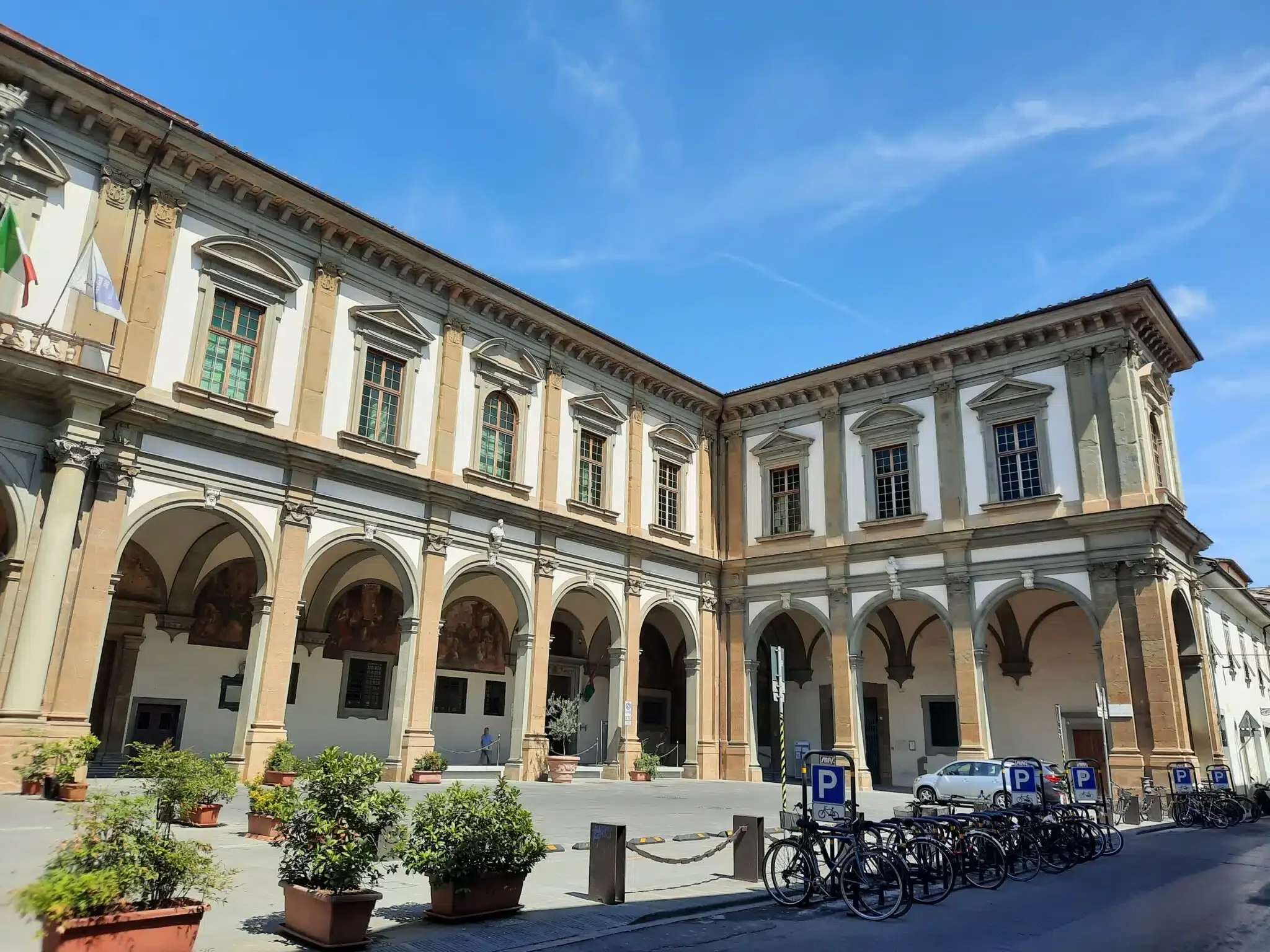
Photo Credit: Fantastic Florence
Santa Maria Nuova Hospital (Ospedale di Santa Maria Nuova) is not just a hospital—it’s the oldest hospital in the world still operating in its original location. Read that again.
Founded in 1288 by Folco Portinari—the father of Dante Alighieri’s muse, Beatrice—it provides a remarkable look at how Florence has cared for its people across centuries, even through the Black Plague and major world wars.
The hospital, then as now, operates on the ancient belief that beauty is a form of medicine; consequently, the on-site museum houses over 700 works of art alongside the evolution of medical tools. Visitors can walk through the Cloister of Bones and the Church of Sant’Egidio, standing in the same halls where Leonardo da Vinci once conducted anatomical dissections that unlocked the secrets of the human body.
Know Before You Go:
Location: Piazza di Santa Maria Nuova, 1 (a 5-minute walk from the Duomo).
Access: Because this is a fully functioning hospital, you cannot wander the medical wards. Entry is restricted to the Percorso Museale (Museum Path) and reservations are required, as is a donation. Tours are available (not required) from Monday to Saturday at 10:30 AM (or the time agreed) and last 1 to 1.5 hours. It is best to book via their foundation to ensure a spot in the cloisters.
San Marco Convent: Fra’ Angelico Without the Crowds

Annunciation by Fra Angelico inside the San Marco Convent
The San Marco Convent is one of Florence’s most peaceful cultural sites, yet its halls hold a complex history of both quiet devotion and fiery radicalism.
Each former monk’s cell is decorated with frescoes by Fra Angelico, including the world-famous Annunciation that greets you at the top of the stairs. These were painted by Fra Angelico not for public display but for private contemplation, intended to "wake up" the friars as they moved through their day. They even served the city's most powerful ruler; Cosimo de’ Medici kept a private double-cell here for his own retreats into silence. The serenity you’ll find at San Marco stands in stark contrast to the quarters of the fire-and-brimstone friar, Girolamo Savonarola, whose three-room suite (cells 12–14) can still be visited today.
The site’s "radical restraint" is best seen in its groundbreaking Michelozzo-designed library, the first library in the West open to the public as a gift of knowledge from Cosimo de' Medici in an era of private wealth. Even in its quietest corners, the convent preserves the city's lost pieces, housing stone fragments salvaged from the 19th-century demolition of the historic Jewish quarter.
Know Before You Go:
Location: Piazza San Marco, 3 (North of the Duomo).
Hours: Generally 8:15 AM – 1:50 PM, but strictly closed on the 1st, 3rd, and 5th Sunday and the 2nd and 4th Monday of every month (it alternates closures with other state museums). Always double-check your specific date.
Tickets: €11 for adults
Time Commitment: 1.5 – 2 hours
Best Time to Visit: Go at 8:15 AM when it first opens. Having the upstairs dormitory to yourself in total silence is a spiritual experience even for the non-religious.
Visiting Florence More Thoughtfully
Florence doesn’t need fewer visitors. It just needs more intentional ones.
By choosing less crowded things to do in Florence, you gain a richer experience while also helping ease pressure on the city’s most strained streets and museums. These quieter sites offer something increasingly rare: the chance to encounter Florence without having to fight for space to do so.
All of the places above can absolutely be visited independently. But in a city layered with political intrigue, artistic rivalry, religious reform, and generational power struggles, context changes everything.
If you’d like to experience these sites with deeper historical and cultural insight, here are a few thoughtful ways to do so.
Explore These Sites With a Local Expert
If you’d like to experience Florence’s lesser-known sites with deeper historical and cultural context, I recommend starting with:
Fantastic Florence Private Tours
Florentine local Francesca Papi and her team offer private guided tours centered around specific themes and off-the-beaten-track locations. I especially recommend her art and food tour through the Oltrarno district, her Jewish Florence walking tour, and her medieval tour of Florence.
→ Learn more about Fantastic Florence
Prefer a Small-Group or Ticketed Option?
If looking for guided visits or booking support to specific sites mentioned above, here are a few well-rated options:
Legacy Michelangelo Walking Tour: A two-hour walking tour tracing Michelangelo’s life through key Florentine sites including Palazzo Vecchio, the Bargello, Santo Spirito, and Santa Croce, ending near the Accademia.
Medici Legends & Renaissance Wonders: A guided exploration of the Medici family’s influence on Florence, including visits to Palazzo Pitti and the Medici Chapels, with insight into how art and power shaped the Renaissance city.
Museo di San Marco Guided Tour: A guided visit to the former Dominican convent, home to Fra Angelico’s frescoes, Savonarola’s cell, the Medici Library, and Ghirlandaio’s Last Supper.
Michelangelo, Machiavelli & Galileo Tour: A guided visit to Basilica di Santa Croce, exploring the tombs of Michelangelo, Galileo, and Machiavelli alongside Giotto frescoes and works by Donatello.
Florentine Hills, Roman Theatre, & Tuscan Farm Experience in Fiesole: A half-day excursion to Fiesole, including the Roman Theater, panoramic viewpoints, and a visit to a Tuscan farm for olive oil and wine tasting.
Craving more Florence content?
This isn’t the only piece on Florence that I’ve written. Click over to my Florence travel hub to find recommendations on where to stay, how to get around the city, Florence-set books to get you in the mood for your trip, and more.
Visit my Florence travel hub→
What to Read Next


