How to Get a SIM Card in Brazil (And Why an eSIM May Be the Easier Option)
Disclosure: This post was created in partnership with SIM Local. I receive compensation as part of this collaboration, but all recommendations and opinions are my own.
Brazil is one of the most rewarding countries to travel, but getting connected when you arrive isn’t as straightforward as you might be used to. Here’s what you need to know about purchasing a SIM card as a tourist in Brazil.
If you’re planning a trip to Brazil, the easiest way to get mobile data is by installing an eSIM before you arrive. A Brazil eSIM connects your phone to local networks the moment you land, without needing to visit a store or register for a local SIM card.
In my experience traveling through Bahia, using a SIM Local Brazil eSIM meant I had data as soon as my plane touched down—making it easy to open Google Maps, order a ride, and figure out where I was going next.
That simplicity matters in Brazil because getting a traditional SIM card isn’t always as straightforward as it is in other countries. Google “Brazil tourist SIM card” and you’ll find plenty of stories about travelers jumping through hoops just to get connected.
If you want to avoid the hassle of buying a SIM after landing, you can browse SIM Local’s Brazil eSIM plans here before your trip.
Unlike places where you can walk into a convenience store and buy a prepaid SIM in minutes, Brazil requires most SIM cards to be registered with a CPF (Cadastro de Pessoas Físicas)—a Brazilian tax ID number. While some stores will register a SIM using your passport, others won’t activate one at all without a CPF.
As a result, many travelers arrive expecting to grab a SIM card at the airport and instead find themselves navigating language barriers, unfamiliar paperwork, or stores charging surprisingly high prices for just a few gigabytes of data.
After traveling through Brazil, speaking with other travelers, and researching the options, here’s what you should know about getting mobile data in Brazil—and why many visitors now choose a Brazil eSIM instead of a traditional local SIM card.
Do You Need a SIM Card in Brazil?
Short answer: yes, if you want an easier trip.
While airports, bus stations, hotels, and cafés often have Wi-Fi, you’ll likely want mobile data for things like:
navigating cities with Google Maps
ordering rides through apps like Uber or 99 (Brazil’s Uber-equivalent)
translating Portuguese (even basic English is not widely spoken in Brazil)
coordinating taxis, tours, or your hotel check-in (nearly all communication is done via WhatsApp in Brazil)
Brazil is a big country, and reliable data access makes traveling through it so much easier.
Can Tourists Buy a Local SIM Card in Brazil?
Yes, tourists can buy a SIM card in Brazil—but the process is often more complicated than in many other countries.
Brazil’s three main mobile providers are:
TIM Brasil
Claro Brasil
Vivo
In theory, buying a prepaid SIM card from one of these carriers is straightforward. In practice, however, many travelers encounter a few hurdles—most notably the CPF requirement.
Most Brazilian SIM cards must be registered to a CPF (Cadastro de Pessoas Físicas), which is a Brazilian tax ID number.
Some stores will register a SIM using your passport, but many employees either don’t know how or aren’t authorized to do it. As a result, travelers sometimes have to visit multiple stores before finding one that can activate their SIM.
There’s also the language barrier to consider. Unless you speak some Portuguese, the activation process can be confusing since it often involves:
Portuguese-only carrier apps
text message verification codes
in-store registration forms
Because of these extra steps, buying a local SIM card in Brazil can take more time than many travelers expect.
What Is the Best eSIM for Brazil?
Because of the complications with local SIM registration, many travelers now choose a Brazil eSIM instead of a physical SIM card.
An eSIM is a digital SIM that you install on your phone before your trip. Instead of swapping physical SIM cards, you simply scan a QR code and your phone connects to a local network as soon as you arrive.
During my time traveling through Bahia, using a Brazil eSIM meant I had mobile data the moment I landed—making it easy to check directions, call a ride, and message accommodation hosts.
Advantages of Using an eSIM in Brazil
no need to visit a store when you arrive
no paperwork or CPF number required
activation usually takes just a few minutes
you can install it before leaving home
your regular SIM can stay in your phone
For most travelers visiting Brazil—especially those arriving late at night or heading straight to smaller towns—an eSIM is often the easiest way to guarantee you’ll have mobile data when you land.
Why I Used a SIM Local eSIM in Brazil
For this trip, I installed a Brazil eSIM from SIM Local before arriving.
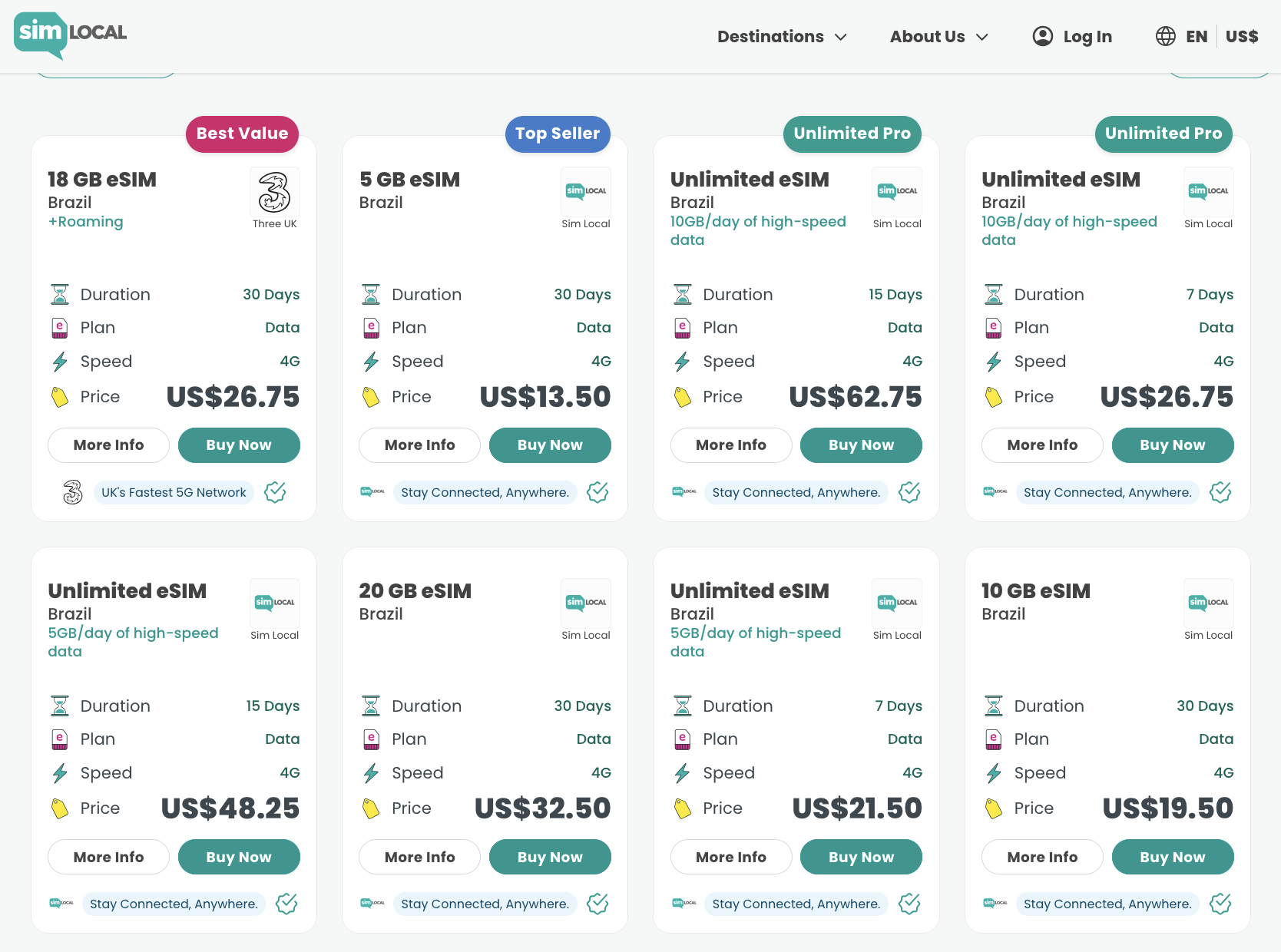
The setup was simple: after purchasing the plan, I received a QR code that I scanned directly into my phone’s settings (instructions here). When my plane landed in Brazil, the eSIM automatically connected to a local network.
During my time traveling through Bahia, my phone connected to TIM Brasil, and I consistently had 4G/5G speeds in cities and beach towns like Itacaré and Salvador. It was fast enough for navigation, messaging, uploading photos, and general travel planning.
One thing I liked about SIM Local is that they work directly with local network providers, which helps ensure stable coverage across the country.
Some SIM Local plans also include calls and texts, and all plans allow hotspot/tethering, which can be helpful when sharing data across devices.
They also offer 24/7 customer support via phone, email, and WhatsApp, and their “Find My Plan” tool helps travelers quickly choose the right data plan based on destination and trip length.
Who Is a SIM Local Brazil eSIM Best For?
A Brazil eSIM from SIM Local can be especially useful for travelers who want reliable data immediately upon arrival.
It’s a particularly good fit for:
Solo travelers: Having mobile data makes it easier to navigate cities, translate Portuguese, and arrange transportation through apps like Uber or 99.
Short trips to Brazil: If you’re visiting for a week or two, an eSIM is usually the simplest option since you don’t have to deal with SIM registration requirements.
Families traveling together: SIM Local plans support hotspot tethering, meaning one phone can share data with multiple devices when needed.
Digital nomads and remote workers: Because SIM Local partners with major local networks, the connection is typically stable enough for navigation, messaging, and general remote work while traveling.
You can explore available Brazil eSIM plans through SIM Local here, and install the eSIM before departure so your phone connects automatically on arrival.
Local SIM vs eSIM in Brazil
Local SIM
Pros: Cheapest for long stays
Cons: CPF registration often required, language barriers
Airport SIM kiosk
Pros: Quick if available
Cons: Often way overpriced, not a guaranteed option at every airport
eSIM
Pros: Instant setup, no paperwork
Cons: Slightly more expensive than local SIM
For short-to-medium trips, most travelers find that an eSIM is the simplest solution.
For long-term stays or digital nomads, getting a local SIM may still be worthwhile once you have time to navigate the registration process and/or get yourself a CPF.
Tips for Staying Connected While Traveling in Brazil
A few additional tips I’ve picked up while traveling Brazil:
Download offline Google Maps before heading to remote areas
Keep screenshots of hotel addresses for taxis
Expect weaker signal in rural beach destinations (the Peninsula de Maraú for example)
Use Uber or 99 instead of street taxis in cities
Having reliable mobile data makes all of this significantly easier. For more Brazil travel tips, read my “What To Know Before You Visit Brazil” guide.
In Summary: The Easiest Way to Get Data in Brazil is With an eSIM
If you want to avoid the complications of buying a local SIM, installing an eSIM before your trip is truly and honestly the simplest option. You can browse Brazil data plans directly through SIM Local and install the eSIM in just a few minutes before departure.
That way when you land, your phone connects automatically—and you can focus on exploring Brazil rather than troubleshooting mobile service.
If you want the simplest way to stay connected while traveling in Brazil, you can check available Brazil eSIM plans from SIM Local here and install one before your trip.
Planning a Trip to Brazil?
You might also find these guides helpful:

Support the Blog While You Travel Brazil
If this guide helped you plan your trip, you can support my work by using the links on my Travel Resources page. I’ve gathered the platforms I personally use—like Booking.com, Busbud, and Viator—and when you book through them, a small commission comes back my way at no extra cost to you. Thank you for helping keep this site running.

The Vale do Pati trek in Chapada Diamantina National Park is one of the most spectacular treks no one’s ever heard of. In this guide, I share what it’s like to do the four-day trek, everything you need to know to do it yourself, and why it’s worth every blister and back ache.